REVIEW · LUXOR
Package deal Hot Air Balloon Ride & Full Day Luxor Tour w/Guide Lunch
Book on Viator →Operated by Luxor Travels · Bookable on Viator
Floating over Luxor beats any postcard. This package pairs a sunrise hot-air balloon ride with a full day circuit of the Valley of the Kings, Deir el Bahari, Karnak, and Luxor Temple. I like that it’s guided by an Egyptologist, so the big sights come with names, gods, and context—not just photos.
Two things I really loved: the private-feeling pace (small group up to 15) with a dedicated guide, and the chance to see multiple tombs beyond the usual one-or-two stops. One thing to consider: it’s an early start and a long day, and Luxor can get brutally hot, so plan for heat and long stretches in the sun between sights.
You’ll get hotel pickup and drop-off, air-conditioned transport between stops, and lunch included. It’s a lot packed into about 10 hours 50 minutes, so you’ll want to go in ready to move, not to linger forever.
In This Review
- Key points to know before you go
- Sunrise hot-air balloon over the Valley of the Kings
- The big payoff: one Egyptologist guide across East and West Bank
- Valley of the Kings tomb stops: what to expect and what to look for
- Tomb of Ramses III (KV 11)
- Tomb of Ramses IX
- Tomb of Merneptah (Tomb 8)
- King Tutankhamun KV62: optional, and worth thinking about
- Deir el Bahari with Hatshepsut: the woman Pharaoh you’ll remember
- Karnak Temple: Amun’s power felt in columns
- Temple of Amun (within Karnak): longer stop, more atmosphere
- Avenue of Sphinxes and the obelisks: the in-between moments that matter
- Avenue of Sphinxes
- Obelisk of Queen Hatshepsut and Obelisk of Thutmose I
- Luxor Temple: Theben Triad and Ramses the Great granite statues
- Price and value: is $140 a fair deal?
- Who should book this Luxor balloon + monuments day?
- Should you book this tour?
- FAQ
- What time does the tour start?
- Is hotel pickup included?
- How long is the full day?
- Does the tour include lunch?
- Are hot-air balloon rides included in the price?
- What entrance fees are not included?
- What happens if the balloon can’t fly due to weather?
Key points to know before you go
- Sunrise balloon over the Valley of the Kings: expect a smooth takeoff and clear views when weather cooperates
- A licensed Egyptologist guide: you’ll get stories that connect tomb art and temple symbolism
- West Bank tomb plan: you’ll visit the best three tombs, with other options that may cost extra
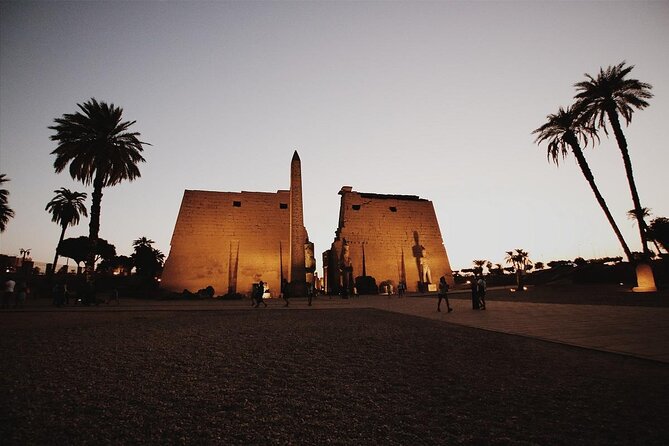
- Karnak + Luxor Temple in one day: you’ll see Amun’s power centers plus the Theben Triad at Luxor Temple
- Small group limit (max 15): easier to ask questions and adjust your pace
- Entrance fees add up: many tombs/temples are listed as paid separately, with a couple marked free under specific ticket rules
Sunrise hot-air balloon over the Valley of the Kings
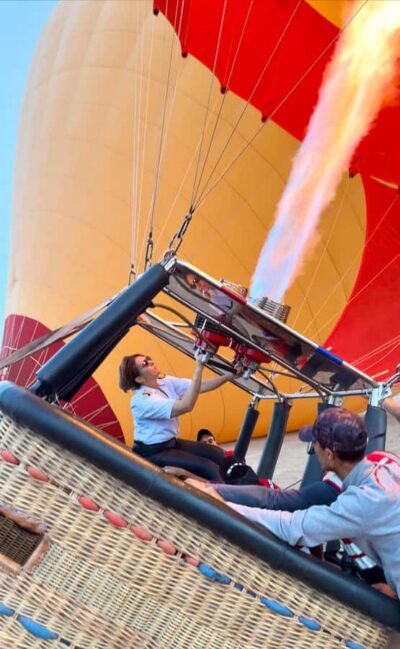
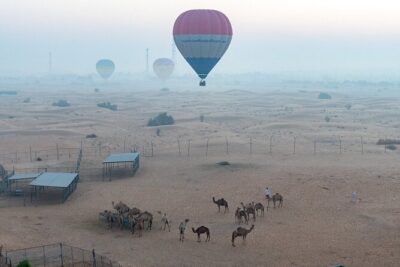
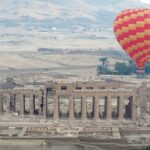
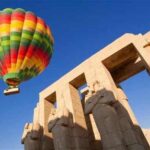
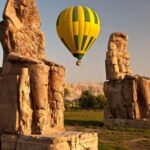
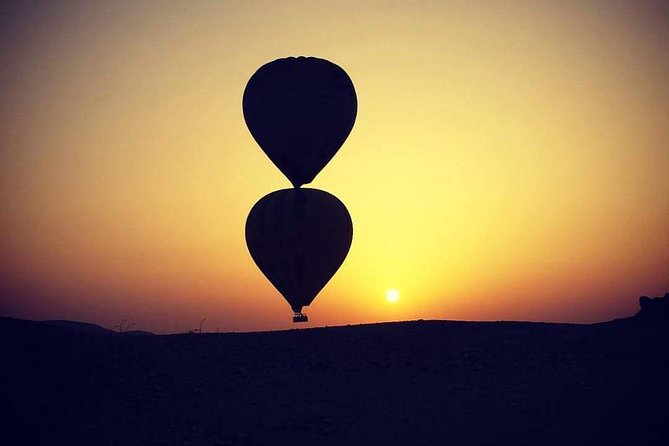
This day starts early, with a meeting time listed at 5:30 am and a balloon ride timed for sunrise. The balloon goes over the Valley of the Kings, which is exactly what you want at first light: the valley is quiet, the light is soft, and the tomb locations make more visual sense once you’ve seen the layout from above.
Balloon rides in Luxor are weather-driven, and this one is no exception. The booking info says it requires good weather, and if your flight gets canceled due to conditions, you’ll be offered another date or a full refund. If you’re the type who hates uncertainty, this might annoy you. If you can roll with it, sunrise ballooning is one of the best uses of time in Luxor because it adds an angle you can’t recreate on the ground.
Based on what people rave about, the balloon experience is typically smooth—takeoff and landing run well when conditions cooperate. And there’s a social perk: you’re not just watching one balloon. You may see dozens launching around the same time, which turns the launch area into a lively early-morning scene before you’re floating above it all.
Practical tip: bring a light layer. Even in hot months, early morning can feel cooler, and you’ll want something easy to pull on/off without a hassle. Also, think about sun protection right after landing, because your day tour starts soon after.
You can also read our reviews of more tours and experiences in Luxor.


The big payoff: one Egyptologist guide across East and West Bank
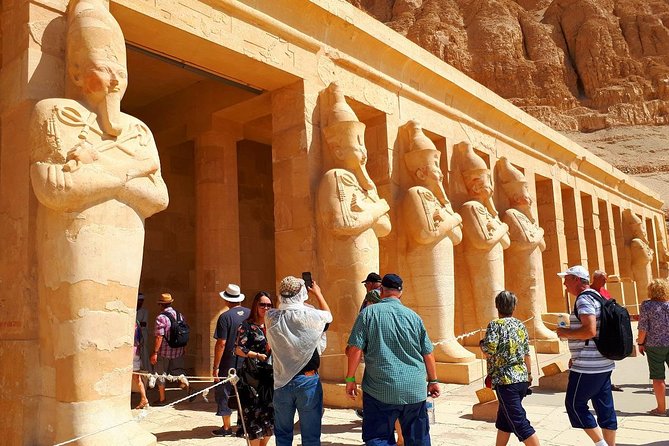
After the balloon, the day shifts into full sightseeing mode via air-conditioned vehicle. The itinerary is built for momentum: tombs first on the West Bank, then temples on the East Bank, including Karnak and Luxor Temple. The guide approach matters here. When your guide can explain why a temple was built, who it honored, and what the artwork was meant to do, you stop seeing monuments as isolated ruins and start seeing them as a single story.
One useful detail: there’s a mix of guided time and short windows where you can explore on your own. That balance helps. You get the guide’s explanations, then you have a chance to look carefully at carvings, inscriptions, and the sheer scale without feeling rushed.
And you’re not dealing with a giant crowd. The group size is capped at 15, which usually means you can ask questions and get answers that fit what you’re noticing—not just a generic script.
Good to know: the day is long enough that you’ll want to pace your energy. You can’t treat every stop like a museum slow-walk. This tour works best if you’re excited to see the highlights and absorb the explanations as you go.
Valley of the Kings tomb stops: what to expect and what to look for
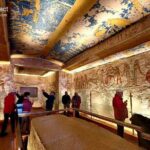
The Valley of the Kings portion is focused and time-boxed: you’ll visit the best three tombs, with your guide helping you choose which ones make the most sense. Each tomb stop is scheduled at about 25 minutes, which means you’ll want a strategy.
Here’s how to make the most of limited time:
- Spend your first minute locating the main scenes and ceiling areas, then let the guide translate what you’re seeing.
- If the colors are faded in parts (common in places exposed over time), focus on the composition: the way figures face, how registers are arranged, and what text appears where.
- Don’t try to memorize everything. Think of tomb art as a system—rituals, gods, and protective magic show up repeatedly.
Your route also includes a couple of tomb options where admission details depend on ticket rules. The tour notes say that admission may be free if you have Valley of the Kings tektites for some tombs. That phrasing is specific, so I’d treat it as a cue to confirm on the day: ask what ticket category qualifies and what you’ll need at the entrance desk.
Tomb of Ramses III (KV 11)
This one is a standout because it’s known for detailed decorations and religious texts. You’ll see colorful painted scenes and ritual material, including things like the Litany of Ra and the Book of Gates traditions. What makes the tomb feel different is the presence of secular-style details in side areas—items that connect the pharaoh to the wider world.
If you look closely while your guide explains, you’ll learn about foreign tributes shown in side rooms, including pottery described as imported from the Aegean region. There are also scenes tied to boats and a set of figures identified as blind harpists, which gave the tomb an alternate name: Tomb of the Harpers.
Even with limited time, KV 11 often rewards you because there’s both text-heavy material and narrative-style scenes layered together. It’s not just pretty walls—it’s a designed message.
Tomb of Ramses IX
Ramses IX’s tomb gets attention for color and ceiling work. One detail I’d watch for is the goddess Nut stretching across the ceiling above the sarcophagi area. Your stop here is short, but that ceiling image is exactly the kind of thing you can track visually even if you don’t catch every translation.
The tomb’s sarcophagus is also described as one of the largest in the valley, even though some paint has deteriorated. That mix—scale plus weathered artistry—is part of what you’ll be seeing in real archaeological spaces. It’s still worth it if you like comparing how different rulers built their afterlife plans.



Tomb of Merneptah (Tomb 8)
Merneptah’s tomb is notable for its blend of mythology, royal burial purpose, and archaeological discovery story. The tour info ties this tomb to the demiurge Ptah and related protective traditions connected with placing deities in tombs. Your guide can connect those ideas to what you see on the walls.
It also includes a real-world archaeology note: the tomb was discovered by Howard Carter in 1903. Even if you’ve heard the name before, having it placed right next to a visit helps the site feel less abstract.
This is a good tomb for visitors who like details. The carvings and layout may not overwhelm you like a blockbuster museum hall, but the storytelling is stronger when someone points out what’s protecting whom and why the scenes appear where they do.
King Tutankhamun KV62: optional, and worth thinking about
The tour gives you a specific option for the Tomb of Tutankhamun (KV62). The entrance fee is listed as 300.00 EGP, and it’s described as optional. If you choose it, the payoff is clear: you’ll get a chance to be face to face with the royal mummy in the tomb.
Should you pay the extra fee? I can’t decide for you, but you can use a simple checklist:
- If King Tut is your main reason for coming to Luxor, adding KV62 is usually the right move.
- If you’re more interested in tomb variety and religious symbolism than in a single celebrity burial, you might decide you’ve already seen enough West Bank art for one day.
Either way, remember that this day is structured to move fast. Choosing KV62 may mean you’ll feel the time pressure more than you would in a slower West Bank-focused tour. But if your heart says Tut, this is the place to satisfy it.
Deir el Bahari with Hatshepsut: the woman Pharaoh you’ll remember
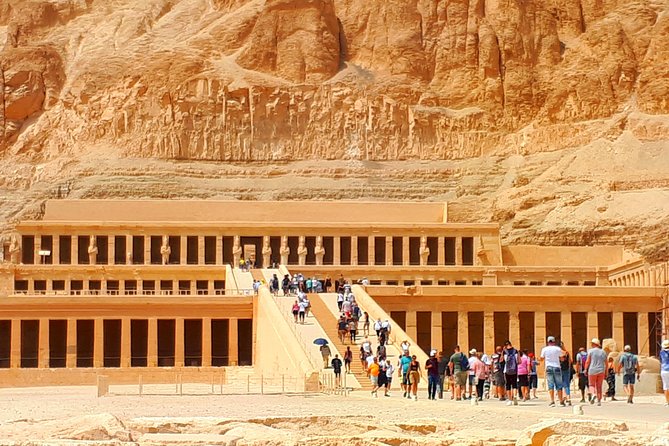
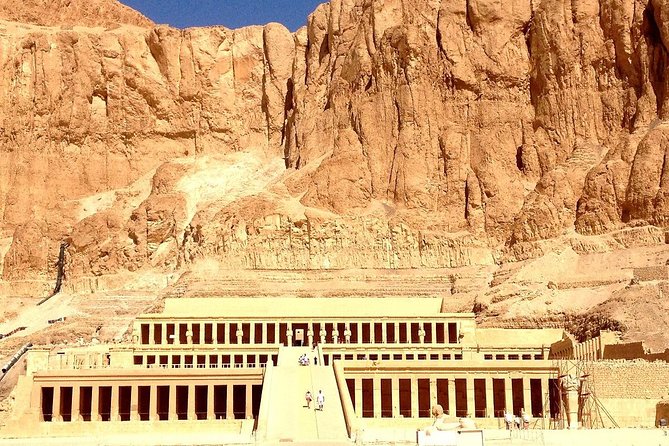
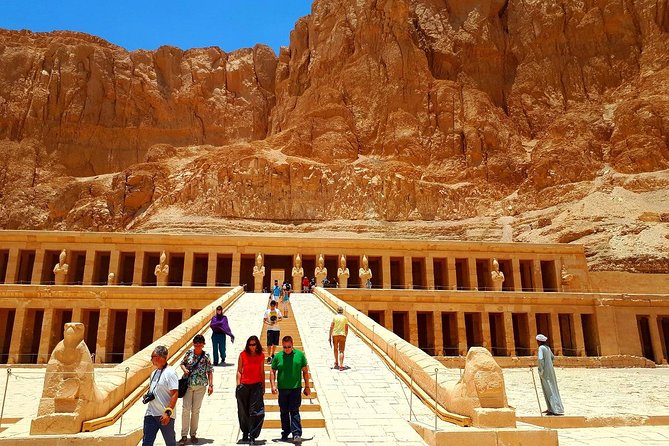
After tombs, you’ll go to Deir el Bahari for the Temple of Queen Hatshepsut. The tour notes call out her as the only woman ever to reign over Egypt as Pharaoh, and they also mention she’s connected to the same dynasty lineage as Tutankhamun.
The listed admission fee here is 140.00 EGP, and your guided time is around 1 hour. This is a temple where the visual arrangement does a lot of the talking. Even when you only have an hour, you can still catch the design logic—how terraces and architectural lines guide your eye and shape the mood of the visit.
A practical tip: this stop is often a heat-management moment. Stay hydrated, use the guide’s explanations to slow your brain down, and take a short break when you can. When your energy is low, it’s harder to absorb the meaning behind the carvings.
Karnak Temple: Amun’s power felt in columns
Next up is Karnak, scheduled for about 1 hour and listed with an entrance fee of 200.00 EGP. Karnak is enormous, and the tour info gives you a concrete scale: the courtyard of Amun-Ra is part of the complex, and the total area mentioned is about 250,000 square meters. Some parts are also in front of restoration work.
Here’s what I’d focus on inside a time-boxed visit:
- The symbolism of dedication to Amun
- The way courtyards and axes make the place feel ceremonial and official
- The rhythm of columns and monumental surfaces
People repeatedly highlight Karnak’s pillars as impressive, and that tracks. Even when you’re tired from a hot day, the column scale forces your body to slow and your eyes to keep traveling upward and across.
Temple of Amun (within Karnak): longer stop, more atmosphere
After the first Karnak segment, the day includes another stop labeled Temple of Amun for about 2 hours, with admission fees listed for the area. This longer window gives you time to move beyond “I saw Karnak” and into “I get what this complex was built to do.”
When a guide points out that Karnak functions like a sacred machine—built for worship, ritual, and political messaging—you start noticing how each part fits together. That’s where a guide adds real value. Without one, it’s easy to get lost in the scale. With one, you start spotting repeating themes: divine authority, royal legitimacy, and ritual purpose.
Avenue of Sphinxes and the obelisks: the in-between moments that matter
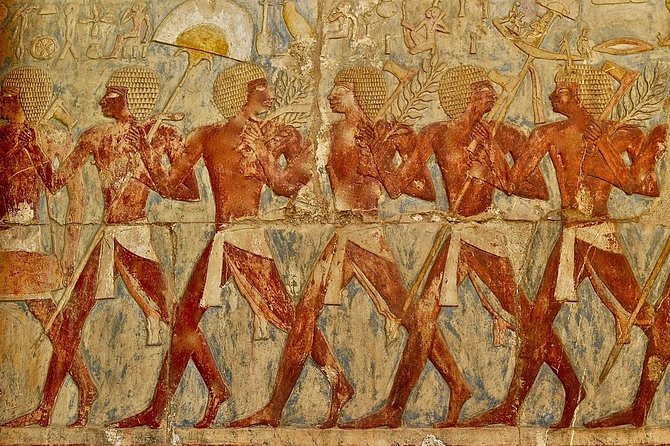
Between major temples, the tour includes monuments that act like links in the story.
Avenue of Sphinxes
You’ll spend about 20 minutes at the Avenue of Sphinxes, described as over 1.5 miles (3 km) once connecting Karnak and Luxor. The key cultural detail here is the Opet festival: statues of Amun and Mut were carried along this route, and the procession symbolized the marriage of these deities.
The tour notes also mention transformation ties to Min at Luxor Temple during the symbolic festival reenactment. It even gives a number: about 1,350 sphinx statues are thought to have lined the road, plus barque chapels with offerings, including six built by Queen Hatshepsut.
In a fast tour, this stop can feel like a breather. That’s good. Use it to reset your brain for Luxor Temple afterward. The story is stronger when your mind has a moment to breathe.
Obelisk of Queen Hatshepsut and Obelisk of Thutmose I
You’ll also see two obelisks, both listed as free:
- The Obelisk of Queen Hatshepsut (about 10 minutes)
- The Obelisk of Thutmose I, described as the smallest of two remaining, with inscriptions on each face (about 10 minutes)
The Thutmose I info includes the idea that he was a warrior-king who extended domains into Nubia and north into Syria, and that he raised a pair of obelisks—only one remains standing today.
Obelisks are easy to skip if you’re tired. Don’t. They’re also some of the best places to practice reading the site the way the ancient builders did: inscriptions matter, and placement matters.
Luxor Temple: Theben Triad and Ramses the Great granite statues
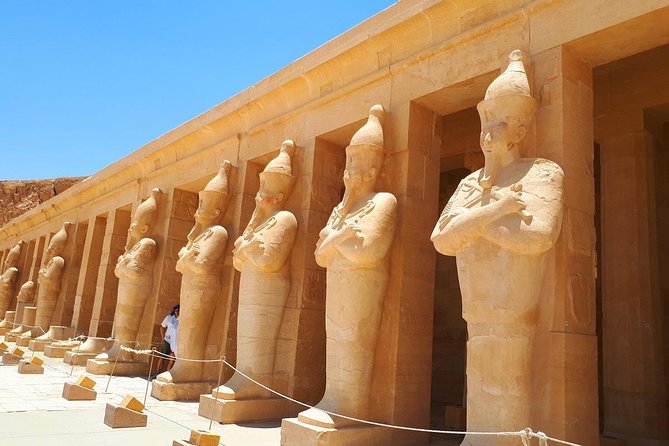
Your East Bank grand finale is Luxor Temple, dedicated to the Theben Triad of Amun-Ra, Mut, and Khonsu. The tour notes mention you’ll see granite statues of Ramses the Great, and you’ll have free time to explore on your own for about 1 hour.
This is where you can finally slow down and look around without feeling like every second is scheduled. The free time is valuable because it lets you process what you’ve just learned at Karnak: how Amun and the wider divine system were represented, and how royal power was visually anchored in stone.
If you’ve been rushing from tomb to tomb, Luxor Temple can feel like a calmer, more coherent ending. It’s also a great place to take photos at eye level instead of constantly craning your neck.
Price and value: is $140 a fair deal?
At $140 per person, this package is priced around the cost of getting a balloon plus a full-day guide and transport. The big value is that you’re not paying separately for the guided day circuit, hotel pickup/drop-off, an air-conditioned vehicle, and lunch. You’re also getting a licensed Egyptologist guide, which matters more than many people realize once you’ve visited a few ancient sites.
That said, entrance fees are not included. The tour clearly lists several paid sites:
- Temple of Hatshepsut at Deir el Bahari: 140.00 EGP
- Tomb of Tutankhamun (optional): 300.00 EGP
- Temple of Karnak: 200.00 EGP
And many other tombs/temples are marked free only under specific conditions tied to Valley of the Kings tektites.
So the real cost is $140 plus whatever you choose to pay at the entrances. My advice: don’t assume. Confirm the day-of which sites are included in your ticket setup and which ones are extra, especially since the “free if you have tektites” rule is unusual.
Who should book this Luxor balloon + monuments day?
I’d book this if you want:
- One intense day that hits both West Bank tombs and East Bank temples
- A guide who can connect symbols, gods, and royal names to what you’re seeing
- A sunrise balloon experience without planning it from scratch
- A small-group feel (max 15) with pickup and lunch handled
You might want a different option if:
- You hate early mornings
- You prefer slow sightseeing with long museum-style time in each tomb
- You don’t want your day affected by weather, since balloon flights depend on conditions
Should you book this tour?
Yes, if you’re visiting Luxor with limited time and you want the best mix of rare views (balloon over the Valley of the Kings) plus must-see monuments on both banks in one go. The guide-led approach makes the sites feel like more than a checklist, and the small group size helps you actually interact with the experience instead of just being herded through it.
Book it with two expectations: it’s a long day, and entrance fees are your extra variable. If you’re okay with those two realities, this is strong value for a first-time Luxor visit.
FAQ
What time does the tour start?
The meeting time is listed as 5:30 am, with the ticket redemption point at the Valley of the Kings in Luxor.
Is hotel pickup included?
Yes. The package includes hotel pickup and drop-off.
How long is the full day?
The duration is listed as about 10 hours 50 minutes (approx.).
Does the tour include lunch?
Yes. Lunch is included.
Are hot-air balloon rides included in the price?
Yes. The hot-air balloon ride is included in the package.
What entrance fees are not included?
Entrance fees are not included overall. The tour info specifically lists fees for some stops, including Hatshepsut’s temple (140.00 EGP), Karnak (200.00 EGP), and the optional Tomb of Tutankhamun (300.00 EGP).
What happens if the balloon can’t fly due to weather?
The experience requires good weather. If it’s canceled due to poor weather, you’ll be offered a different date or a full refund.